




Scale Enterprise AI with Search Intelligence

Boris Toledano
COO & Co-founder
After embedding Linkup into their AI advisory tool, this leading Big 4 firm saw output accuracy improve by 27%, internal adoption rise by 35%, and time-to-delivery drop by 17%, across thousands of consultants over six months.
Introduction
A leading global consulting and accounting firm has hundreds of thousands of consultants operating in highly regulated, information-intensive environments. Its teams produce strategic analyses, financial models, market forecasts, and operational recommendations that directly inform executive decision-making at the highest levels.
The organisation set out to address a persistent operational challenge: consultants routinely carrying late-night workloads driven by the volume and depth of preliminary research required on every engagement. The auditor rebuilt its internal AI tool using Linkup’s web search retrieval layer. Grounding outputs in live, source-attributed information improved response accuracy, which in turn increased internal adoption of the tool and accelerated time to client-ready delivery.
Why generative capability alone fails in consulting workflows
The firm’s internal AI tool was powered by leading foundation models (recently GPT5) to assist with drafting, summarization, and structured content generation. However, the limitations of model-only architectures quickly surfaced.
Consulting engagements require timely industry developments, current market sizing and CAGR projections, cross-geography competitive intelligence, and sector-specific regulatory context. Without live access to external information, their AI tool was limited to training data and internal documentation, creating compounding risks:
- Staleness: Outputs could not reliably reflect recent market developments, transactions, regulatory updates, or competitive moves, reducing relevance in fast-moving sectors.
- Coverage Gaps: Niche, emerging, or highly localized topics (e.g., regulatory changes in specific jurisdictions or sub-scale markets) were insufficiently covered, leading to incomplete analyses.
- Credibility Constraints: Consultants were unable to independently verify or confidently cite outputs for client-facing deliverables, limiting adoption in high-stakes engagements.
- Hallucination Risk: Unverified or fabricated information represents a material professional risk. Hallucinations are a primary barrier to production deployment and can damage firm reputation, particularly in light of recent industry controversies (e.g., the Deloitte, Spring 2025).
Rebuilding the Firm’s AI tool with Linkup
For the firm, an output is only as valuable as its defensibility. Generative capability alone was insufficient.
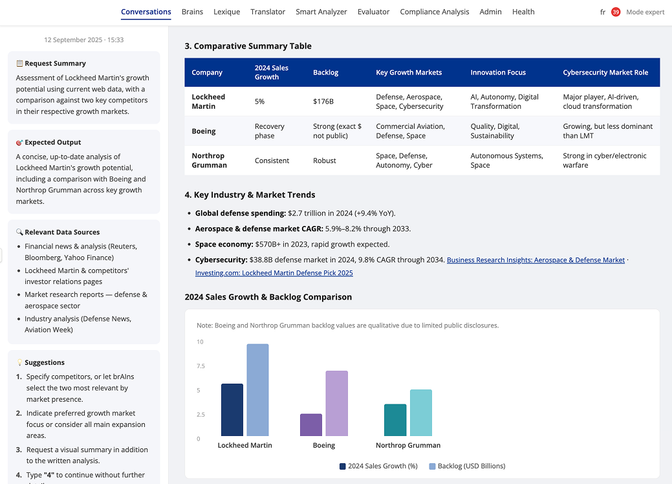
They rebuilt its internal AI tool with Linkup as the web retrieval layer, fundamentally changing how the system operates. Rather than generating answers from static memory or financial databases, it now retrieves current, structured information in real time before reasoning begins.
Linkup provides stronger international coverage than traditional search engines and is particularly effective at handling multi-intent queries. Because Linkup serves a large number of global enterprises operating across jurisdictions, industries, and regulatory environments, our proprietary index retrieves diverse and regionally relevant sources – not just high-traffic or SEO- visible content. Linkup is also optimized for multi-entity and multi-hop queries (read more in our benchmark here) – retrieving results that span company, geography, regulatory framework, and thematic dimensions within a single search.
The resulting system operates as follows:
Query decomposition. A consultant submits a research request in natural language. Linkup’s prompt engineering pipeline then identifies the core subjects, required analytical depth, and source constraints. For instance, for the prompt “Conduct a comprehensive strategic analysis of [Company Name]’s water strategy and 2024 water policy”:
- Core subject: water strategy, water stewardship, 2024 water policy.
- Required analytical depth: strategic alignment, risk exposure, operational maturity, long-term resilience, peer benchmarks.
- Source constraints: public disclosures, ESG reports, regulatory filings, credible third-party assessments.
Search-grounded hypothesis formation. Their internal platform leverages Linkup to retrieve recent, relevant web sources. Linkup returns LLM-ready snippets with source attribution, ranked based on semantic relevance and source quality. The system constructs a structured hypothesis layer from this retrieved context, ensuring analysis is grounded in fresh information rather than model memory alone.
Model reasoning and synthesis. The structured context is passed to foundation models (GPT, Anthropic) for reasoning, summarization, and structured output generation. Because the factual claims are already grounded in retrieved sources, the model's role is synthesis and formatting rather than recall.
Deliverable generation. Once the analysis is synthesized, the system formats outputs according to user needs such as written summaries, Excel tables, charts, and slide-ready content. All outputs are generated within a secure, enterprise-grade environment designed for confidentiality, auditability, and compliance.
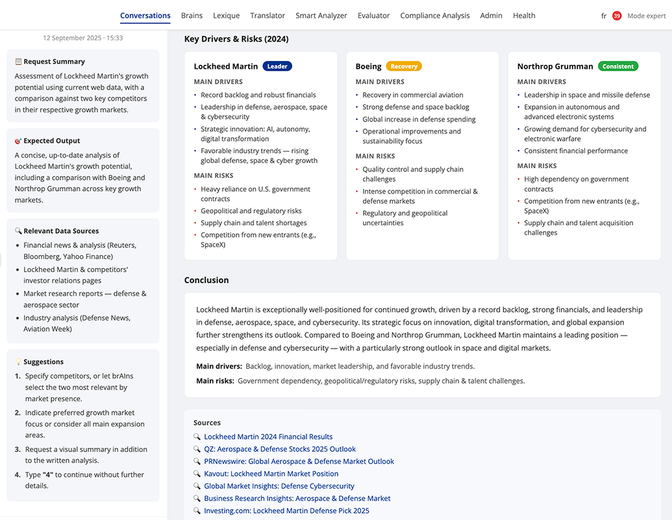
The impact: accuracy as an adoption driver
In professional services, adoption is driven by reliability. If consultants are not confident in the quality of outputs, they revert to manual workflows.
Following the Linkup integration, the firm measured performance improvements, assessed against the prior without Linkup or just with a couple of rigid database retrieval pipeline over a six-month window across several thousand active users:
- +27% increase in output accuracy, measured against analyst-verified benchmarks for factual claims in research outputs.
- +35% increase in internal adoption rates, tracked as active weekly users relative to the available user base.
- -17% reduction in time-to-delivery for client-facing research workflows, measured from request submission to deliverable sign-off.
The improvement in accuracy had a direct impact on consultant trust. Outputs were grounded in recent, verifiable information, supported by traceable sources, aligned with observable global market developments, and quantitatively defensible with clear links to underlying data.
Beyond quality gains, Linkup helped the firm’s internal AI tool realize enterprise-scale resilience. The system supports thousands of their employees running concurrent deep research workflows. Linkup’s infrastructure handled this sustained load while delivering state of the art retrieval performance and consistency.
Research phases that previously required manual navigation and verification across multiple external sources were compressed into a single workflow. Junior consultants, who traditionally bear the burden of preliminary research, experienced a meaningful reduction in repetitive information-gathering tasks. The firm’s teams gained access to structured, up-to-date industry intelligence that could be incorporated directly into client recommendations.
Looking forward: what this means for enterprise AI
The firm’s experience highlights a broader pattern in enterprise AI adoption: generative systems become operationally reliable when retrieval is embedded into the reasoning pipeline. As professional services organisations scale AI across advisory workflows, systems must securely integrate external and internal knowledge sources, ground outputs in verifiable information, and align with how structured analysis is utilized in practice.
These benefits expand with enterprise-grade retrieval. Linkup enables higher data refresh rates, enhancing time-sensitive use cases, and targeted indexing of domain-specific sources such as regulatory filings, legal databases, and proprietary research. Linkup’s enterprise plans provide both standardization and precision. They enable a single, governed AI search infrastructure that serves highly differentiated departmental needs – all without compromising consistency, accuracy, security, or compliance.
Want to explore how Linkup’s web retrieval technology can strengthen AI deployments in your organisation? Try it for free here or learn more from our team here.