
Why developers are choosing Linkup over Exa

The Linkup Team
If you are comparing Linkup vs Exa for an AI application, the short answer is: Linkup wins on factual accuracy, predictable pricing, and GDPR compliance. Exa wins on semantic discovery and entity enrichment. For most production RAG pipelines and AI agents, Linkup is the stronger choice. Both APIs are purpose-built for AI developers and operate proprietary web indices. The right choice depends on what your application does with retrieved content and what your cost model looks like at scale.
How Each API Retrieves Information
The most important difference between Linkup and Exa is where semantic matching happens, and this determines retrieval precision for everything downstream.
Exa's index unit is the web page. When Exa crawls the web, it converts each page into a single document-level embedding. When you query Exa, the engine matches your query against those page-level embeddings and returns the most semantically similar pages. You can then optionally request highlights, which are query-relevant excerpts extracted from those pages after retrieval. The semantic matching, however, already happened at the page level: what you get is the best-matching document, not necessarily the best-matching fact.
Linkup's index unit is the information fragment. Each page is chunked into distinct semantic units at index time, and each chunk is embedded separately. When you query Linkup, the engine matches your query directly against those fragments. You receive the specific piece of content that answers your question, not the full document it lives in. The grounding is tighter because the match happened at the level of meaning, not the level of the page.
This architectural difference has real consequences:
- For semantic discovery, finding pages similar to a reference, exploring a topic neighborhood, building entity lists, Exa's page-level approach is well-suited. Its Websets product is particularly strong here.
- For RAG pipelines, compliance research, and multi-entity fact-checking, where you need the right fact and not the right document, Linkup's fragment-level retrieval produces more precise, lower-hallucination results.
Accuracy: What the Benchmarks Show
On simple, single-fact retrieval, both providers perform well. The gap becomes significant on complex, multi-hop queries, which are the workloads that define production AI agents.
On SimpleQA, OpenAI's factuality benchmark across science, politics, arts, and technology:
Provider | SimpleQA F-Score |
Linkup | |
Exa | 63% |
Perplexity Sonar | ~82% |
On Linkup's open-source complex query evaluation, 600 queries drawn from real user traffic with blind LLM-as-judge scoring:
- Linkup retrieved up to 3x more unique source domains per query
- Missing-entity rates were up to 4x lower
- Linkup had the lowest hallucination rates across all four providers tested
The benchmark methodology and evaluation code are publicly available for replication.
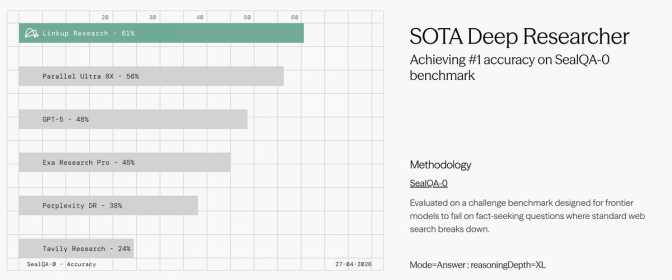
On our Researcher, we ranked #1 on the SealQA-0 benchmark for sourced QA.
Pricing: What You Actually Pay
Exa's published price is $5–7 per 1,000 requests depending on tier. In practice, most AI applications need page content alongside results, and each additional content type is a separate billing line.
Configuration | Linkup | Exa |
Standard search with answers (1K queries) | $5.00 | $5.00 (answer endpoint only) |
Search + page content, 10 results (1K queries) | $5.00 | $8–17 ($7 search + $1/1K per content page) |
Search + 50 results per query (1K queries) | $5.00 | $11.00 ($7 + $4 for extra results) |
Deep research, multi-step, synthesized (1K queries) | $50.00 flat | ~$375–400 ($5/search op + $5–10/page read x N pages) |
The deep research comparison is the most significant. Exa's research tier compounds per search operation and per page read. A query that reads 70 pages internally costs roughly $375 per 1,000 calls. Linkup Deep Search is flat at $50 per 1,000 queries, regardless of how many internal steps are required.
Provider | Cost per 1K queries | Predictable? |
Linkup Standard | $5.00 | ✅ |
Exa answer-only | $5.00 | ✅ |
Exa search + content (10 results) | $8–17 | ❌ |
Linkup Deep | $50.00 | ✅ |
Exa deep research | ~$375–400 | ❌ |
Linkup has two tiers and two prices, with no per-result, per-content, or per-token charges on top.
Latency
Speed was historically one of Exa's clearest advantages. With the launch of Exa 2.0, Exa Fast now delivers sub-350ms P50 latency, which is genuinely fast.
Linkup launched its own Fast tier in February 2026 at sub-second latency, at the same $5 per 1,000 queries as Standard. Both providers now offer competitive real-time performance. The differentiation has shifted back to accuracy and cost.
Tier | Linkup | Exa |
Sub-second / fast | Fast: $5/1K (Feb 2026) | Fast: from $5/1K (sub-350ms) |
Standard / auto | ~2s: $5/1K | ~1–2s: $7+/1K |
Deep / multi-step | 10–60s: $50/1K | Variable: $15 to $400+/1K |
Compliance
For some organizations (e.g., banks, government or even start-ups operating in highly regulated industries) the compliance posture of a search provider is part of the infrastructure decision.
Linkup is a web search API built with compliance, data residency, and enterprise security as structural requirements.
We operate multiple regional indexes and can guarantee local data processing across the EU, US, Canada, Australia, and APAC. Linkup also supports zero data retention, a signed Data Processing Agreement (DPA) and SOC 2 Type II certified control.
These capabilities are especially relevant for enterprise procurement, regulated industries, and organizations that need to demonstrate where data is processed and how it is governed to internal or external auditors.
Linkup vs Exa: At-a-Glance Comparison
Linkup | Exa | |
Retrieval approach | Fragment-level (chunks indexed separately) | Page-level (document embeddings + optional highlight extraction) |
SimpleQA accuracy | 94% | 63% |
Complex query accuracy | 2–4x better entity coverage | Strong on single-hop |
Standard + content cost (1K queries) | $5 flat | $8–17 (stacking) |
Deep research cost (1K queries) | $50 flat | ~$375–400 (compound) |
Real-time freshness | ✅ Sub-minute | Refreshed every minute (Exa 2.0) |
GDPR / EU data residency | ✅ | ❌ |
Primary use case | Factual grounding, RAG, multi-hop agents | Semantic discovery, enrichment, Websets |
When to Choose Linkup vs Exa
Choose Exa if your primary use case is semantic discovery or entity enrichment, such as finding content similar to a reference, building lead lists, or exploring a topic through neural similarity. Its Websets product is purpose-built for this and has no direct equivalent in Linkup.
Choose Linkup if your use case centers on factual accuracy, multi-hop research, or production RAG pipelines where hallucination rates and source diversity matter. If you are expanding in Europe or working in a regulated industry, Linkup is the only option with GDPR compliance built into the infrastructure. At scale, Linkup's flat pricing model also makes cost forecasting significantly more reliable.
FAQ
What is the main difference between Linkup and Exa?
The core difference is where semantic matching happens. Exa indexes and matches at the page level: you get the most relevant document, with optional highlight extraction after retrieval. Linkup indexes and matches at the fragment level: each page is chunked at index time, and retrieval returns the specific piece of content that answers your query. This produces more precise grounding for AI agents handling complex or multi-entity questions.
Is Linkup better than Exa for RAG?
Yes, for most RAG use cases. Linkup's fragment-level retrieval reduces context window noise and produces lower hallucination rates. On SimpleQA, Linkup scores 94% vs 63% for Exa. For complex, multi-hop queries, the kind that define production agents, Linkup retrieves up to 3x more unique sources and has up to 4x lower missing-entity rates.
Is Linkup cheaper than Exa?
For standard search with page content, Linkup is cheaper and more predictable. Linkup Standard is $5 per 1,000 queries regardless of result count or content type. Exa charges $7 per 1,000 queries for search, plus additional fees per content page and per extra result. For deep research, the difference is dramatic: Linkup Deep is $50/1K flat; Exa's research tier can reach $375–400/1K depending on how many pages are read internally.
Which is better for AI agents: Linkup or Exa?
Linkup is generally the better choice for AI agents that need factual accuracy, multi-hop reasoning, or grounded answers. The fragment-level retrieval model is better aligned with how agents consume context. Exa is a strong choice for agents focused on discovery tasks, such as finding similar companies, surfacing adjacent entities, or exploring topic neighborhoods.
Does Linkup work with LangChain, LlamaIndex, and other AI frameworks?
Yes. Linkup integrates with LangChain, LlamaIndex, CrewAI, n8n, Zapier, and Make, as well as direct API access via Python and JavaScript SDKs.
Is Linkup GDPR-compliant?
Yes. Linkup is the only European web search API, with EU data residency, zero data retention, SOC 2 Type II certification, and a signed DPA available for enterprise deployments. Exa does not offer equivalent compliance for European organizations.
Can I use Linkup instead of Exa in my existing application?
In most cases, yes. Linkup offers a simple REST API and SDKs for Python and JavaScript, and integrates with the same orchestration frameworks as Exa (LangChain, LlamaIndex, CrewAI, MCP). The main migration consideration is that Linkup returns information fragments rather than full documents, so prompts that previously expected full page content may need adjustment.
Ready to give your AI systems the context they need? Try it for free or talk to our team.