




Retrieves live user feedback and market insights for customer support

Philippe Mizrahi
CEO & Co-founder
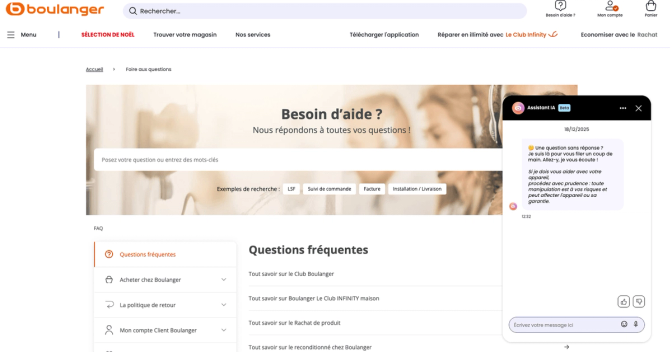
Boulanger is one of France’s leading consumer electronics retailers, operating at scale across a broad and fast-moving product ecosystem. As customer expectations for instant and accurate support continue to rise, the company deployed a customer-facing chatbot on its website to handle a growing volume of support requests.
To make this chatbot effective beyond basic inquiries, Boulanger integrated Linkup’s web search technology. This allows the system to retrieve information from the web when internal documentation is insufficient, ensuring customers receive accurate and current answers regardless of where the information is published.
The Challenge: Beyond Traditional RAG
Customer support in consumer electronics presents structural challenges. Customers frequently ask questions that extend beyond a retailer’s internal knowledge base. These include product specifications maintained by manufacturers, compatibility information involving third-party devices, troubleshooting steps documented by external communities, and details that evolve faster than internal documentation processes.
While Boulanger had extensive internal resources, relying solely on internal data limited the ability of traditional RAG systems to address the full range of customer inquiries. The company needed a way to handle questions that could not be anticipated or maintained in advance. The approach was similar to what we had the opportunity to show with our partner Fleet a few months ago.
The Approach: Web-Powered Intelligence
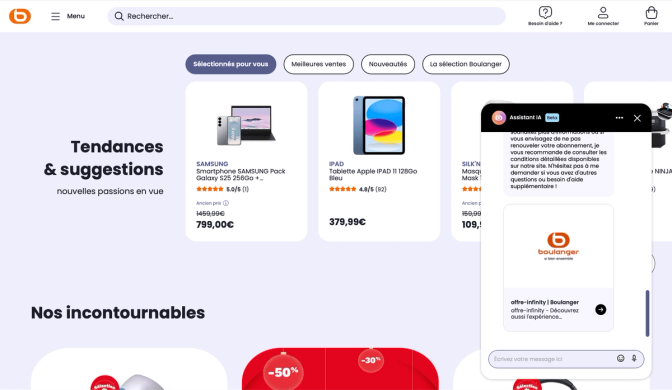
Boulanger’s approach was to augment its support chatbot with web search capabilities rather than attempting to expand internal documentation indefinitely. Linkup enables source prioritization, allowing Boulanger to favor reliable sources such as manufacturer websites, official documentation, suppliers, competitors, and established technology publications. The chatbot then consolidates information from internal and external sources into a single response presented to the customer.
From the user’s perspective, this process is invisible. Customers receive a clear answer without needing to understand where the information originated.
- Query analysis When a customer submits a question, the system first evaluates whether it can be answered using Boulanger’s internal knowledge base.
- Intelligent routing For questions requiring external information, such as product compatibility or troubleshooting for newly released devices, the chatbot leverages Linkup’s web search to retrieve authoritative and current sources.
- Source verification Linkup’s prioritization capabilities allow Boulanger to favor trusted sources, ensuring response quality and consistency.
- Unified response The chatbot synthesizes information from both internal and external sources into a single answer. Customers simply receive the help they need.
Why This Works
The primary value of this approach lies in autonomy and simplicity.
Support agents, whether human or AI-based, are no longer constrained by predefined knowledge boundaries. They can access information published by manufacturers, suppliers, competitors, and third parties across the web. This reflects how experienced support agents already operate, but in a structured and scalable way.
At the same time, Linkup is particularly effective at navigating Boulanger’s own public website. In many organizations, information is distributed across multiple internal systems and databases, introducing complexity and inconsistency. The customer-facing website is often the most accurate and up-to-date representation of what customers should know, precisely because it is maintained for external use.
Using the public website as a primary reference simplifies knowledge management. It avoids duplication and reduces reliance on fragmented internal tools. This approach is common in practice, even if rarely formalized. Linkup enables it to be applied consistently within an automated support system.
The Impact: Measurable Business Value
Area | Impact | |
Resolution speed | Web-enabled customer support allows issues to be resolved more quickly by providing immediate access to relevant information. This reduces waiting times for customers and lowers the need for follow-up interactions or escalations. | |
Resolution quality | Traditional chatbots often redirect requests without fully resolving them. By accessing external sources such as manufacturer documentation and community resources, web-enabled systems are better positioned to deliver complete and accurate answers, including for complex or edge cases. | |
Support workload | Automating the handling of routine inquiries reduces the volume of requests that require human intervention. This allows support teams to concentrate on cases that demand judgment, personalization, or exception handling. | |
Customer experience | Customers receive clear and timely answers to common questions related to product specifications, compatibility, and troubleshooting. Reduced effort and faster access to information contribute to a more consistent and satisfactory support experience. | |
Revenue | Timely and accurate answers during the customer journey can influence purchasing decisions. Addressing specific, unanticipated questions at the point of need helps reduce friction and supports conversion without requiring direct human involvement. |
Why Web Search Matters for Retail
Consumer electronics retail presents structural constraints that limit the effectiveness of internal-only knowledge systems.
- Product diversity Product assortments span a large number of manufacturers, each maintaining its own specifications and support materials. Maintaining complete and current internal documentation across all product variations is difficult in practice.
- Pace of innovation New products and software updates are released continuously, often faster than internal documentation can be updated. Relevant information is therefore frequently available externally before it is reflected in internal systems.
- Ecosystem complexity Customer questions often involve interoperability across multiple brands and devices. Answering these questions requires knowledge that spans manufacturers and suppliers and is typically distributed across the web.
- Community-driven knowledge Practical troubleshooting solutions are often documented by user communities and early adopters before they appear in official channels. Web search allows support systems to incorporate this external knowledge in a controlled manner.
Looking Forward: The Future of B2C Support
Boulanger’s deployment illustrates a practical approach to customer support automation based on retrieval rather than prediction. By combining internal knowledge with controlled access to the public web, the company ensures that customer questions are answered using the most relevant and up-to-date information available.
Web search plays a central role in grounding responses, particularly in environments where information is fragmented across manufacturers, suppliers, competitors, and community sources. Instead of attempting to centralize all knowledge internally, this approach treats the web, including the company’s own public website, as an operational source of truth.
For customer support use cases, this model improves accuracy, coverage, and consistency without increasing the burden of knowledge maintenance. It aligns support systems with how information is actually published and consumed, and provides a scalable foundation for handling complex and evolving customer inquiries.
—
Want to learn how Linkup's web search retrieval technology can transform your customer support?
Reach out at contact@linkup.so