

Linkup: web search for AI agents, no human account needed

Philippe Mizrahi
CEO & Co-founder
Today, Linkup adds support for x402, the open payment protocol developed by Coinbase.
Introduction
AI agents are increasingly capable of working on long, complex tasks, autonomously. They can research companies, monitor markets, draft reports, and send emails, all without waiting for a human to push them forward. Projects like OpenClaw, the open-source autonomous agent that became the most-starred software project on GitHub earlier this year, give a concrete picture of what this looks like in practice: agents running 24/7, picking up tasks, and executing them while their owners sleep.
But there's a practical bottleneck that's easy to overlook: most APIs, including web search APIs, still require a human to create an account before an agent can use them. Someone has to sign up, verify an email, enter a credit card, and copy an API key into a config file. That's not a major problem when a developer is setting up a tool once. It becomes a real constraint when you want agents to operate with genuine independence, spinning up resources and accessing services on their own.
Today, Linkup becomes one of the first web search API to remove this bottleneck entirely, through support for the x402 payment protocol.
What x402 is
HTTP has had a status code called 402, "Payment Required", since the early 1990s. It was always intended for future use, when the web would have a native payment layer. That layer never arrived, and 402 sat unused for over three decades.
x402 is an open standard, developed by Coinbase, that finally gives 402 a purpose. The idea is simple: instead of requiring an account or an API key to access a paid resource, a server can respond to any unauthenticated request with a 402 status code, a price, and a wallet address. The client, whether it's a browser, an app, or an AI agent, reads those payment details, signs a USDC transfer using its own wallet, and resends the request with that signed payload. If the payment is valid, the server returns the resource.
The whole thing happens over standard HTTP. No redirect, no checkout flow, no account creation. Payment verification and on-chain settlement are handled by a facilitator, Coinbase provides one, and Stripe has built native support for x402 as part of their push into machine-to-machine payments, so the API provider doesn't need to maintain blockchain infrastructure. The agent just makes a request, pays, and gets its answer.
From an agent's perspective, accessing a paid API becomes as simple as accessing a free one. The only requirement is a funded wallet.
Why this matters specifically for web search
An AI agent doing research is only as good as the information it can access. For many agentic workflows, competitive monitoring, market research, fact-checking, due diligence, real-time web search is a core capability, not a nice-to-have.
The quality of those results matters too. An agent is only useful if the information it retrieves is accurate, not just recent, but correctly sourced and grounded. Linkup is built specifically for AI systems, which is part of why it ranks at the top of independent search accuracy benchmarks.
Web search is also one of those capabilities that agents need to use repeatedly, often unpredictably, and at any hour. An OpenClaw agent tasked with producing a daily briefing on competitor activity doesn't call the search API once. It calls it many times, across many queries, on an ongoing schedule.
To see why this matters, it helps to compare the two flows side by side.
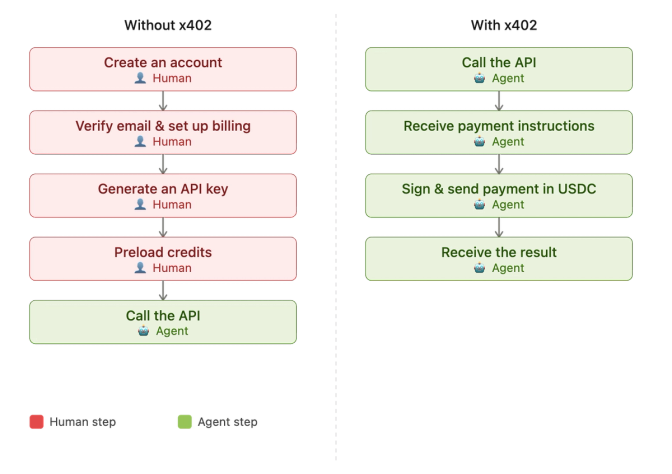
The difference isn't just convenience. Steps 1 through 4 of the traditional flow aren't just tedious, they're structurally incompatible with agents that are supposed to operate independently. An agent can't create an account. It can't verify an email. It can't enter a credit card. Every one of those steps is a hard dependency on a human being available to do it. x402 removes those dependencies entirely.
This is exactly the access pattern that x402 is designed for. Instead of a monthly subscription tied to a human account, the agent pays per request, in real time, using its own wallet. No human needs to be involved in the billing relationship at all.
How to use Linkup via x402
Linkup's search and fetch endpoints are all accessible via x402. No account required, no API key, you just need a wallet with USDC on the Base network.
Any x402-compatible client will work. The example below uses the Linkup SDK, which handles the payment handshake automatically, but you can also implement the flow directly using the @x402/core and @x402/evm packages with any HTTP client:
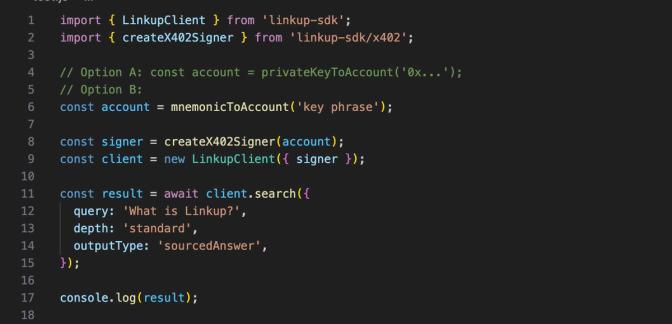
The signer handles the payment automatically. When the Linkup API returns a 402, the SDK reads the payment details, signs a USDC transfer from the wallet, and retries the request, all in a single function call.
For the full reference, including supported parameters and response formats, see the x402 documentation.
How payments actually settle
When a request arrives without authentication, Linkup's API responds with a 402 and a payment-required header. This header contains the amount, the deposit address, the network (Base), and the asset (USDC). The client SDK reads this, constructs a signed payment payload using the EIP-712 or EIP-3009 standard, and resends the request with that payload in a payment-signature header.
Linkup then sends the signed payload to a payment facilitator, Coinbase's facilitator service on Base, which verifies the signature and settles the transaction on-chain. Once settlement is confirmed, Linkup returns the search results with a payment-response header containing the transaction hash.
The whole process adds minimal latency to the request. For the agent, it's largely invisible.
Two companies have played a central role in making this infrastructure real. Coinbase created the x402 protocol and operates the facilitator service that verifies and settles payments on Base. Stripe, which has been building support for machine-to-machine payments, worked closely with us to bring x402 to Linkup, their team’s support and documentation made it significantly easier to implement the protocol correctly and reliably. Together, they're providing the payment rails that let agents transact without any of the friction that comes with traditional payment systems: no checkout flows, no card networks, no manual reconciliation. Just a signed payload and an on-chain settlement.
What this enables in practice
Consider an agent like OpenClaw, configured to monitor a set of competitors and flag meaningful changes. The agent runs on a schedule, queries the web for recent news and product updates, and synthesizes a report. Previously, someone would need to provision API access manually, creating a Linkup account, managing an API key, keeping an eye on usage. With x402, the agent funds its own wallet, makes requests as needed, and the operator never has to touch the API access layer.
Or consider a multi-agent system where a higher-level orchestrator delegates research tasks to sub-agents dynamically, based on incoming work. Those sub-agents may spin up and wind down unpredictably. Tying each one to a pre-provisioned API key is operationally painful. Letting each sub-agent pay per request from a shared wallet is much cleaner.
More broadly, x402 makes it possible to build agentic workflows where the agent's access to information scales naturally with its activity, without anyone having to manage the billing relationship manually.
Getting started
If you already use Linkup with an API key, nothing changes. x402 is an additional access path, not a replacement.
If you want to start using Linkup via x402, all you need is a wallet funded with USDC on Base. If you don't have one yet, Coinbase's Agentic Wallets is the easiest way to provision a wallet specifically designed for autonomous agents, it handles key management, spending controls, and funding in a few commands. The full Linkup quickstart is in our x402 documentation.
Questions? Reach us at support@linkup.so, on Discord, or book a 15-minute call with someone from our technical team.