


Introducing SPARSEUP-v2 by Linkup Research

Thibault Formal
Head of Research
Try SPARSEUP-v2 now on Hugging Face: Linkup-Platform/linkup-sparseup-embed-v2
- Paper on arXiv: https://arxiv.org/pdf/2611.09680
- Model on Hugging Face: Linkup-Platform/linkup-sparseup-embed-v2
- Pretrained checkpoint: Linkup-Platform/linkup-sparseup-embed-v2-pretrain
- Visualization: Linkup-Platform/sparseup-embed-v2-visualization
Today, Linkup Research is releasing the v2 version of our SPARSEUP family of models. Building on the first SPARSEUP model [2], we push sparse encoders further with a new model that reaches 57.2 nDCG@10 on BEIR-15 [8]. It sets a new state of the art for sparse encoders under 150M parameters, surpassing SlideOn [6] and matching the late-interaction model LateOn [1].
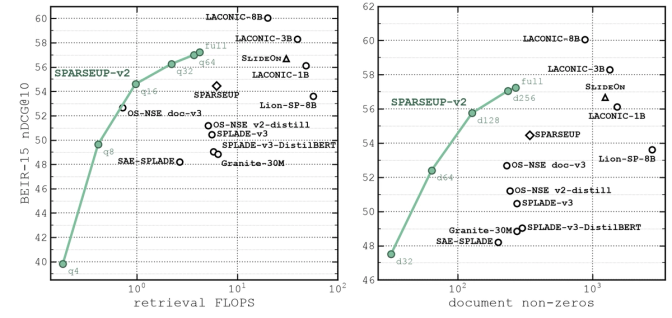
SPARSEUP-v2 achieves the top result among sparse retrievers on MTEB (v2, eng). We also extend our evaluation well beyond BEIR with 12 additional datasets spanning medical, legal, financial, chemical, reasoning-intensive, and long-document retrieval. Across this suite, SPARSEUP-v2 is the strongest sparse model, outperforming SlideOn on 11 of 13 benchmarks. It also ranks first overall on recall, and second only to the late-interaction model LateOn on ranking metrics, while being far cheaper to serve (see plot below).
TL;DR
- SPARSEUP-v2 reaches 57.2 nDCG@10 on BEIR-15 at 150M parameters. It matches its late-interaction sibling LateOn and beats SlideOn (56.7) at about 7× fewer retrieval FLOPS.
- On MTEB(eng, v2) retrieval tasks it scores 59.7 nDCG@10, the best score of any sparse retriever reported on the leaderboard, which was previously held by SlideOn at 58.6.
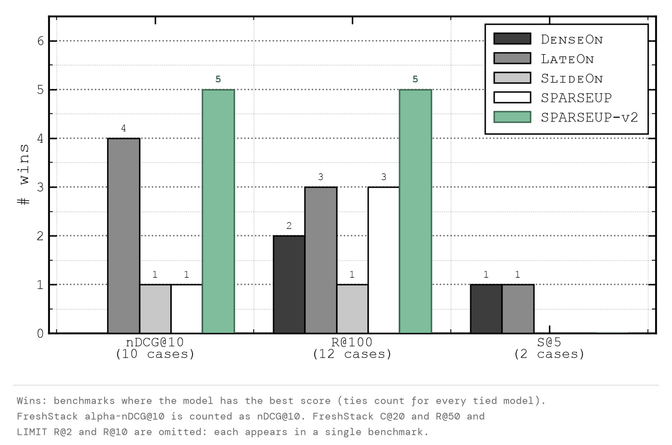
- Beyond BEIR, across 12 additional benchmarks, it achieves the most wins: best nDCG@10 on 5 of 10 benchmarks and best R@100 on 5 of 12.
- Three ingredients: contrastive pre-training on large scale data, distillation from cross-encoder, matryoshka training.
Contrastive Pre-Training
The DenseOn and LateOn [1] recipe comprises two training stages:
- Contrastive pre-training (CPT) [data] on 665M weakly supervised pairs — a pair being a [query, document] tuple. The supervision is not manual: it is derived from document structure, with most pairs using a document's title as the query and its passage as the positive.
- Supervised fine-tuning (SFT) [data] on 1.88M pairs from standard collections such as TriviaQA and MS MARCO, which provide human relevance labels as well as teacher scores from a cross-encoder.
The first version of SPARSEUP skips the first stage and is initialized from the LateOn CPT checkpoint, pre-trained in the multi-vector modality. This initialization already yields a clear improvement over the plain ModernBERT [3] backbone (+2.1 nDCG@10 on BEIR-13). While working on SPARSEUP, we asked whether running CPT directly in the sparse modality could bring further gains, i.e., whether a modality gap was limiting SPARSEUP with respect to DenseOn and LateOn. A hint in this direction is that, in the literature, sparse encoders often match or outperform dense encoders of comparable size, whereas SPARSEUP was still lagging behind DenseOn.
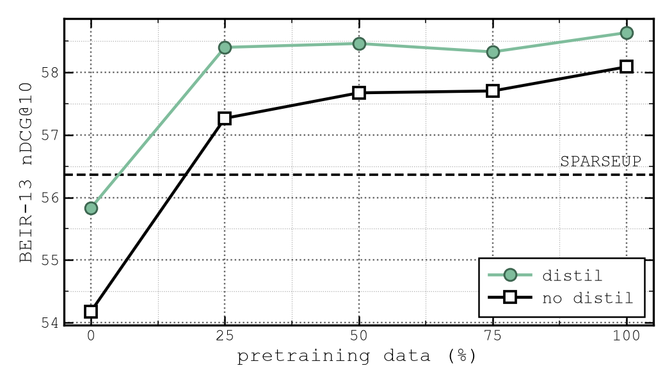
To answer this question, we ran CPT with the learned sparse retrieval architecture on increasing fractions of the pre-training corpus, followed by the same supervised stage as SPARSEUP, both with and without distillation. The plot below reports BEIR-13 nDCG@10 as a function of the fraction of CPT data used; the "0" point corresponds to the ModernBERT backbone without CPT.
CPT turns out to be decisive. With only 25% of the pre-training data, sparse CPT improves over the ModernBERT initialization by roughly 3 nDCG points and over SPARSEUP initialized from LateOn by roughly 1.6 points. Cross-modality pre-training is therefore better than no pre-training, but it consistently lags behind pre-training in the target modality. This advantage comes at a cost: the full CPT run takes roughly 3.5 days on 4 NVIDIA H100 GPUs, about 50× the fine-tuning time. To ease the development of competitive sparse encoders, we release the model after weakly supervised pre-training.
Knowledge Distillation
Knowledge distillation (KD) is the silver bullet for practitioners in their hunt for better retrieval models, especially in combination with hard negatives. It helps for two reasons. First, the teacher provides a fine-grained signal: instead of a binary relevant / non-relevant label, the student sees how relevant each document is to the query. Second, the teacher scores every candidate document, including the mined hard negatives, for which we have no human relevance judgment: some of them are in fact relevant to the query, and the teacher's score says so, where the contrastive loss alone would treat them all as equally wrong. We therefore add distillation to our recipe. We reuse the training data from the supervised stage, which already comes with teacher scores from a strong cross-encoder reranker, mxbai-rerank-large-v2[4]. The training objective combines the InfoNCE loss with a Kullback–Leibler (KL) divergence term between the teacher and student score distributions over the candidate documents, which pushes the student's predictions as close as possible to the teacher's. A weight λ controls how much the KL term contributes.
Distillation and contrastive pre-training interact, so we evaluate them together (see the plot above). Distillation helps at every CPT budget, but its benefit shrinks as the backbone sees more pre-training data. The gap between distilled and non-distilled models goes from +1.7 points without CPT to +1.1 at 25%, +0.8 at 50%, +0.6 at 75%, and +0.5 at 100%.
As a result, a distilled model trained on only 25% of the CPT data (58.4 nDCG@10) already slightly outperforms a non-distilled model trained on all of it (58.1), and is within 0.2 points of the distilled model with full CPT. Fine-tuning costs a small fraction of pre-training, so distillation is a cheap substitute for a large share of the pre-training budget. Combining full CPT and distillation, we reach 59.2 nDCG@10 on BEIR-13, +2.8 points over SPARSEUP.
Matryoshka Learning
As the last ingredient of SPARSEUP-v2, we therefore adopt Matryoshka-style training [5], which optimizes a single model for several pruning budgets at once. This is a nice-to-have property for sparse encoder, yielding multiple efficiency-effectiveness operational points. At each training step, we compute the loss on the full representations and on three pruned versions of them, keeping only the top 16, 32, and 64 entries for queries and the top 64, 128, and 256 entries for documents. The final loss is a weighted sum of the four, with most of the weight (0.8) on the unpruned level, so that pruned effectiveness does not come at the expense of the full model.
The plot below reports BEIR-13 nDCG@10 under inference-time pruning, with and without Matryoshka training. On the left, queries are capped at 64 entries and we vary the document budget; on the right, documents are capped at 256 entries and we vary the query budget.
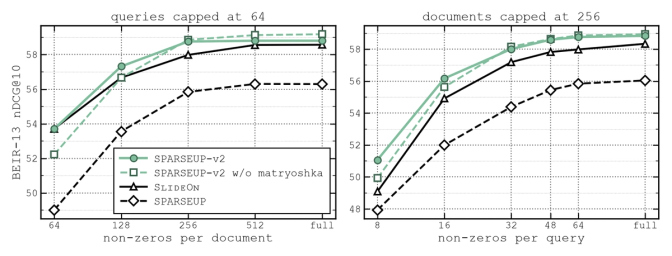
Matryoshka training pays off where pruning is most aggressive. It improves nDCG@10 by 1.5 points at 64 entries per document and by 0.7 at 128; on the query side, by 1.1 points at 8 entries per query and by 0.5 at 16. At larger budgets the two variants are on par, and without pruning Matryoshka costs at most 0.4 points. The Matryoshka model also outperforms SPARSEUP by 2.5 to 4.7 points at every budget. It matches SlideOn at the most aggressive document cap and outperforms it everywhere else, with the largest margins under aggressive query pruning (+2.0 points at 8 entries per query, +1.3 at 16).
Results
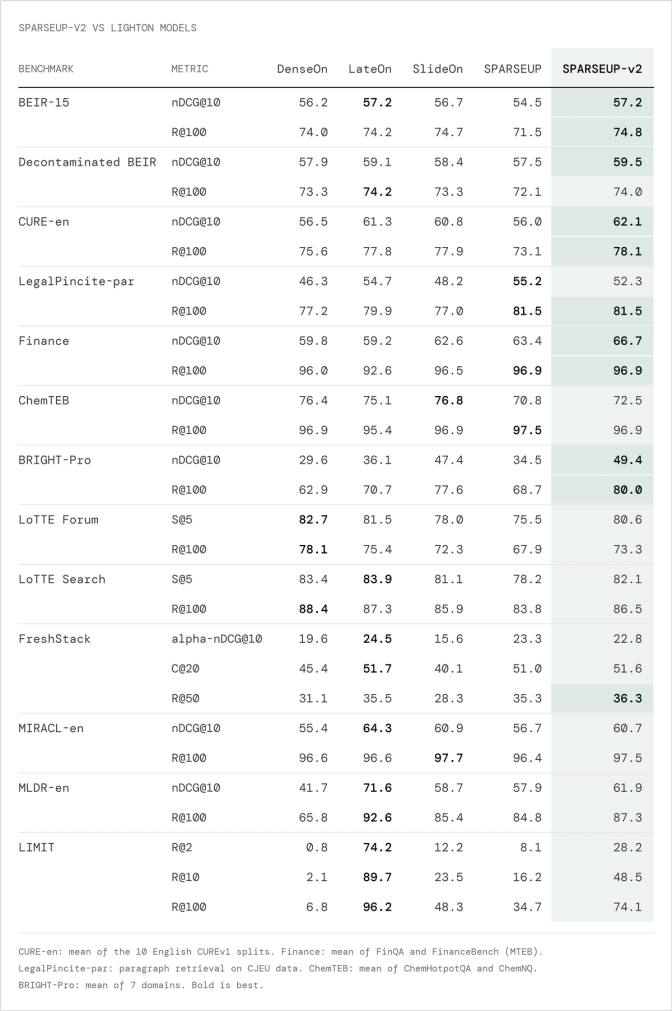
Putting the three new ingredients together, SPARSEUP-v2 reaches 57.2 nDCG@10 on BEIR-15. The table below compares it against DenseOn, LateOn, SlideOn, and the original SPARSEUP on a large collection of benchmarks.
SPARSEUP-v2 obtains the best nDCG@10 on BEIR-15, decontaminated BEIR, CURE-en, Finance, and BRIGHT-Pro. It also reaches the best MTEB (eng, v2) retrieval score of any sparse model on the leaderboard (59.71 nDCG@10), which was previously held by SlideOn (58.62). On LoTTE, the main weakness of SPARSEUP, it gains +5.1 S@5 on Forum and +3.9 on Search. LateOn remains ahead on long documents (MLDR-en) and on LIMIT, and ChemTEB is the main exception among the domain benchmarks: there SPARSEUP-v2 trails SlideOn and DenseOn by about 4 nDCG@10 points.
Efficiency. The figure below places SPARSEUP-v2 among other learned sparse retrievers, with two ways of measuring cost. On the left, we prune queries and report the retrieval cost in FLOPS. On the right, we prune documents and report the average number of non-zero entries per document, which directly sets the size of the index. Thanks to Matryoshka training, every point of the green curve comes from the same model.
Without any pruning, SPARSEUP-v2 reaches 57.2 nDCG@10 on BEIR-15 at 4.2 FLOPS. SlideOn reaches 56.7 at 30.9 FLOPS, so SPARSEUP-v2 is more effective at about 7× lower FLOPs. Keeping 64 entries per query costs only 0.2 points and brings the cost down to 3.7 FLOPS. With 16 entries per query, SPARSEUP-v2 still matches SPARSEUP v1 (54.6 vs 54.5) at 6× fewer FLOPS. The only models above the curve are LACONIC-3B and LACONIC-8B, which have 20 to 60 times more parameters [7].
The same picture holds for index size. Unpruned, SPARSEUP-v2 stores 269 entries per document on average, 4.6× fewer than SlideOn (1,241) and 5.6× fewer than LACONIC-1B (1,516), while scoring higher than both. With 128 entries per document, it still scores 55.8, 1.3 points above SPARSEUP v1, which needs 342.
Contributing authors
Thibault Formal | Head of Research
Pierre Erbacher | Research Scientist
Cosimo Rulli | Research Scientist
Paulo Moura | Research Scientist
References
[1] DenseOn with the LateOn: Fully Open Dense and Late-Interaction Models for Multilingual, Long-Context, and Code Search. arXiv:2607.27178
[2] SPARSEUP: Towards Better Recipes for Training Modern Learned Sparse Retrievers. arXiv:2611.09680
[3] Smarter, Better, Faster, Longer: A Modern Bidirectional Encoder for Fast, Memory Efficient, and Long Context Finetuning and Inference (ModernBERT). arXiv:2412.13663
[4] mxbai-rerank-large-v2. Hugging Face
[5] Matryoshka Representation Learning. arXiv:2205.13147
[6] SlideOn & mSlideOn: Sparsified late-interaction and dense retrievers. Hugging Face Blog
[7] LACONIC: Dense-Level Effectiveness for Scalable Sparse Retrieval via a Two-Phase Training Curriculum. arXiv:2601.01684
[8] BEIR: A Heterogeneous Benchmark for Zero-shot Evaluation of Information Retrieval Models. arXiv:2104.08663